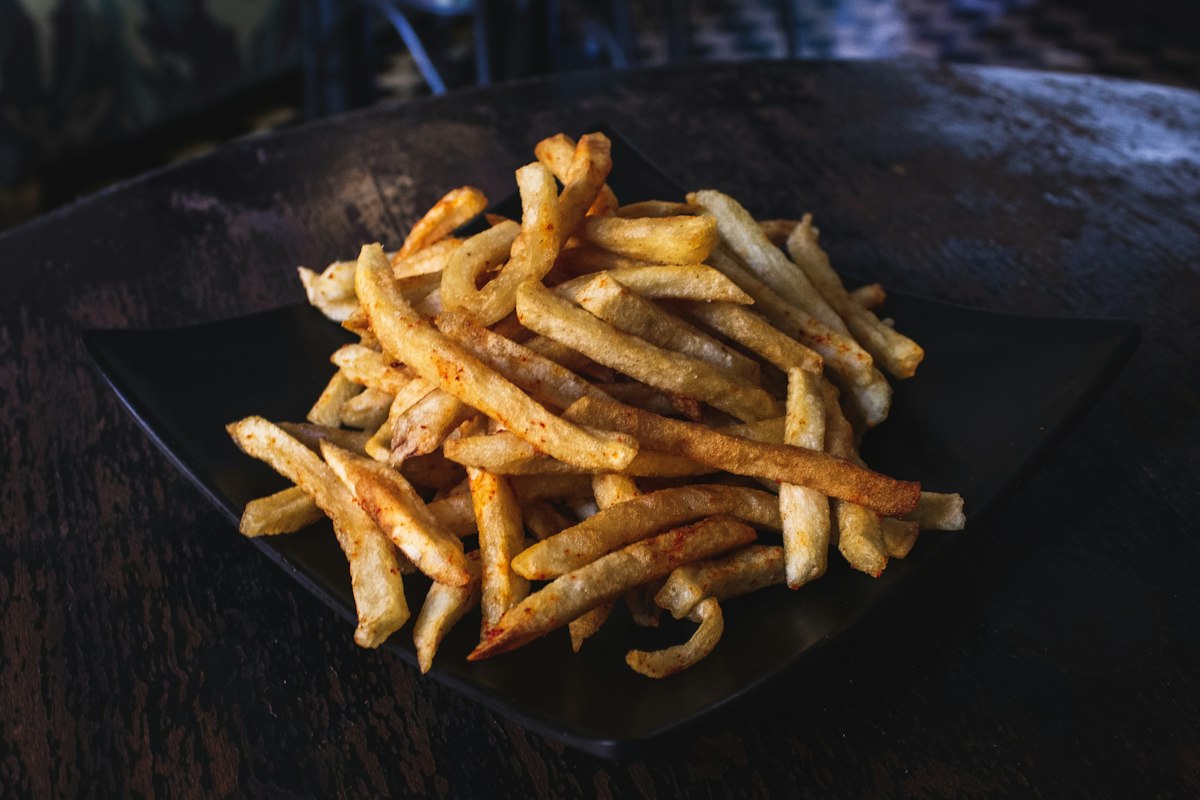
It Is Not Just a Feeling
People eat our fries and say things like "these taste different" or "I don't know what it is but these are better." That's not an accident, and it's not marketing. There's actual food science behind why beef tallow produces a better fry than canola or vegetable oil, and once you understand the mechanisms, the result stops being a mystery and starts making complete sense.
This post is the full explanation. You don't need a chemistry background to follow it. Nashville already understands the fundamental principle intuitively: fat is flavor, and the quality and type of fat matters. The science just explains exactly why.
The Maillard Reaction: Where Fry Flavor Comes From
The most important flavor-generating process in cooking is called the Maillard reaction. It was described by French chemist Louis-Camille Maillard in 1912, and it's responsible for the brown color and complex flavor in everything from a seared steak to a toasted piece of bread to the crust on a well-made fry.
Here's how it works. At temperatures above roughly 280°F, the amino acids (from proteins) and the reducing sugars on the surface of a food start reacting with each other. This reaction produces hundreds of different flavor and aroma compounds simultaneously, along with the characteristic brown pigmentation called melanoidins. The result is what we associate with "cooked" flavor: roasty, savory, complex, deeply satisfying.
In frying, this reaction happens at the surface of the potato as soon as the moisture in the outer layer is driven off by the hot oil. The speed and completeness of the Maillard reaction at the fry's surface depends heavily on two things: the temperature of the frying medium, and how stable that temperature stays throughout the fry.
Beef tallow maintains temperature more consistently than vegetable oils because it doesn't oxidize and degrade as quickly. A stable frying temperature means a more complete, even Maillard reaction at the fry surface. That translates directly to better crust flavor and color.
Smoke Points and Fat Stability: The Real Story
You'll often see oil comparisons that focus heavily on smoke point, the temperature at which an oil starts visibly smoking. Beef tallow has a smoke point around 400°F, which is perfectly adequate for frying at the ideal range of 325 to 375°F. But smoke point alone is only part of the story.
The more important variable is oxidative stability: how resistant the fat is to breaking down chemically when exposed to high heat and oxygen over time. This is where the saturated versus unsaturated fat distinction becomes crucial.
Why Saturated Fat Behaves Better in a Fryer
A fatty acid molecule can be visualized as a chain of carbon atoms. In a saturated fat, every carbon in the chain is bonded to as many hydrogen atoms as it can hold. There are no "open" bonds. The molecule is chemically stable, especially when heated.
In an unsaturated fat (like canola or sunflower oil), some carbons in the chain have double bonds with neighboring carbons instead of being fully loaded with hydrogen. These double bonds are reactive sites. When exposed to heat and oxygen, they break and react with oxygen to form new compounds, a process called oxidation. Oxidation produces off-flavors and odors in the oil. It also creates compounds like aldehydes and ketones that are absorbed by the food being fried and contribute an unpleasant stale or "oily" taste.
Beef tallow is approximately 50% saturated fat. Canola oil is roughly 7% saturated. Soybean oil, the base of most generic vegetable blends, is about 16% saturated. The difference in stability under sustained high-heat frying is significant and measurable.
| Fat | Saturated Fat % | Oxidative Stability | Flavor Contribution | Fry Crust Quality |
|---|---|---|---|---|
| Beef Tallow | ~50% | Very High | Rich, savory depth | Thick, durable crust |
| Canola Oil | ~7% | Moderate | Neutral to slightly bitter | Thin, fragile crust |
| Soybean / Veg Blend | ~16% | Moderate-Low | Neutral, flat | Thin crust, fast softening |
| Peanut Oil | ~18% | High | Slightly nutty, clean | Good crust, holds well |
| Coconut Oil | ~90% | Very High | Distinct coconut flavor | Excellent, but flavored |
The Flavor Compounds in Tallow Itself
Beyond the structural benefits of a stable fat, beef tallow contributes actual flavor compounds to the fry. This is the part that vegetable oil simply cannot replicate.
Tallow contains a range of volatile aromatic compounds that are the same ones associated with beef flavor. These include lactones (which produce buttery, creamy notes), branched-chain fatty acids (which contribute the specific meaty aroma associated with beef), and other lipid-derived compounds generated during the rendering process. In concentrations too subtle to taste as "beefy," they add a savory, rich background to anything fried in tallow.
Think about how Nashville BBQ pitmasters talk about the fat cap on a pork shoulder and what it does to the meat as it renders. The fat doesn't just lubricate, it flavors. Tallow works the same way in a fryer. The flavor transfer is subtle but real, and it's the difference between a fry that tastes like a potato and a fry that tastes like something you want more of.
Every serious BBQ joint in Nashville knows that the fat from the meat is part of the flavor, not a byproduct to be discarded. The drippings from a smoked brisket are a cooking medium. Beef tallow in a fryer is the same principle with a different application. Fat is flavor. Nashville already knew this.
The Science of a Better Crust
The crust on a fry forms through a process called dehydration and starch gelatinization. As the potato hits hot oil, the water in the outer layer rapidly vaporizes and escapes as steam. The potato starches at the surface, now depleted of moisture, undergo a structural transformation and set into a rigid, porous layer. That layer is the crust.
The quality of the crust depends on how fast and how completely that dehydration happens. A hot, stable fat that maintains its temperature when a cold potato hits it drives the dehydration process faster and more uniformly. A fat that drops in temperature when loaded (because it's already partly degraded and has lower thermal capacity) produces a slower, incomplete dehydration. The result is a thinner, less uniform crust that can't hold up as long after the fry leaves the oil.
Tallow, being denser and more thermally stable than most vegetable oils, recovers temperature faster after a batch of cold fries is added. This consistency is part of why our fries come out with a crust that actually stays crunchy through a realistic catering service window at Nashville events, not just for the thirty seconds after they leave the fryer.
Putting It All Together
So why do beef tallow fries taste better? Here's the complete picture.
- Tallow maintains temperature more consistently, which supports a cleaner, more complete Maillard reaction at the fry surface.
- Its high saturated fat content resists oxidation, so the cooking environment stays clean and the oil doesn't contribute off-flavors to the food.
- The natural flavor compounds in tallow transfer a subtle savory richness to the fry that neutral seed oils cannot replicate.
- The thermal stability of tallow drives faster, more complete crust formation, producing a thicker, more durable crust that holds up after the fry leaves the oil.
Every one of these factors points in the same direction. The food science lines up exactly with what Nashville BBQ culture has always understood by feel: the fat you cook with is not neutral. It is part of the dish. Choose the right fat, and the food gets better. That's what we're doing with every order of fries we put out.